Oops! Something went wrong while submitting the form.
Highline Beta builds new businesses. Some with corporate partners, some our own. Every one of them depends on the same input: a clear read on whether the people we're building for actually have the problem we think they have.
Getting that read is the hardest part of the job.
They skip it because of the calendar.
Recruiting takes weeks. Panels cost real money. The audiences that matter most are usually the hardest to reach: the VP of marketing at a 5,000-person company, the procurement lead, the specialist nurse, the operations manager who has no interest in taking your call.
Meanwhile the decision has a date on it. The stage gate is in three weeks. The roadmap gets locked at the end of the quarter. The concept list goes to the brand team on Friday.
So teams make the call on internal judgment and give it a more confident name. We've watched it happen inside big companies. We've done it ourselves in our own ventures, more times than we'd like to admit.
That gap is what Candor was built to close.
Candor is a synthetic user research platform. You describe the audience you want to understand, Candor builds synthetic participants from real evidence, and you interview them.
It works in three stages.
Synthetic research has an obvious failure mode. A language model will produce fluent, plausible, confident answers about any population you name, and those answers can be completely hollow. Believability gives false credibility to bad conclusions, which makes it worse than no research at all.
Our answer to that is evidence and provenance.
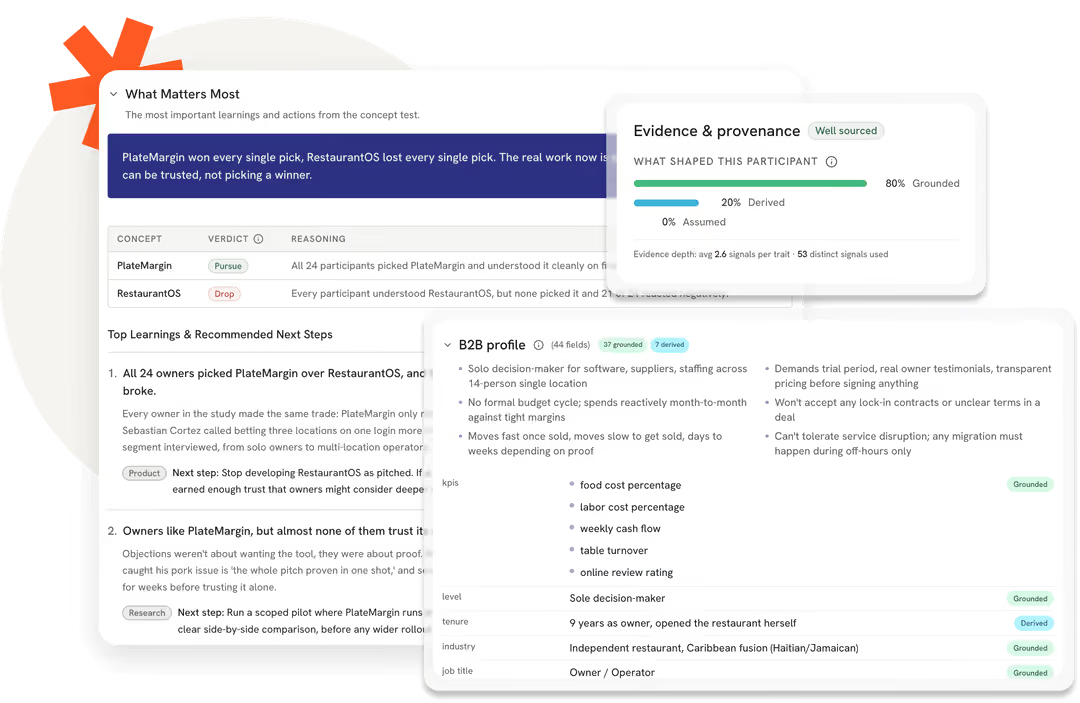
We connect participant attributes to the source data: grounded from a specific place, derived if the attribute is sourced from multiple pieces of evidence and assumed when the model fills in the gaps. Critics run throughout the process to make sure hallucinations are at a minimum.
Too many synthetic user research platforms are black boxes. We want to be the opposite.
Candor doesn't replace talking to humans. We say that on the site and in sales calls, and we'll keep saying it, because the teams we respect most are the ones who push back hardest on this point.
The sequencing we recommend is roughly 80/20. Run the first round synthetically. Spend your recruiting budget and your customers' time on the final 20% where the decision is expensive and the stakes are high.
In practice that looks like a few specific moves:
Be equally clear about where it doesn't work. Synthetic participants are good for directional signal, cold starts and exploring how variables interact. They are weakest exactly where research earns its keep: genuine surprises, real minority views, exceptional people, and populations that are honestly undecided. What comes out of Candor is a set of grounded hypotheses, not findings. Treat it that way and it makes your research stronger. Treat it as a substitute for customers and it will eventually embarrass you.
We built Candor because we needed it. We now run it on our own ventures and our client work, and the biggest change has been the sequence. Research starts in week one of a concept instead of week three, which means the questions we take to real customers are far better by the time we get there.
You can start with a free project at runcandor.com. If you'd rather have someone walk you through it first, book a demo.