Oops! Something went wrong while submitting the form.

Every innovation portfolio we’ve seen has them. Projects that aren't dead, but aren't really alive either. Still staffed. Still on the roadmap. Still soaking up budget and attention. Going nowhere.
It’s important to point out that zombie ventures aren't a sign of bad people. They're a sign of a bad system. When individual incentives don't reward honest assessment, when success criteria were never set in advance, and when the culture treats any kind of stopping as failure, zombies are the inevitable output. You can't inspire your way out of it. You can't run a workshop on "being more ruthless." You have to build a system where ruthlessness is just the natural result of looking at the data honestly.
When you do look honestly, you really only have three choices.
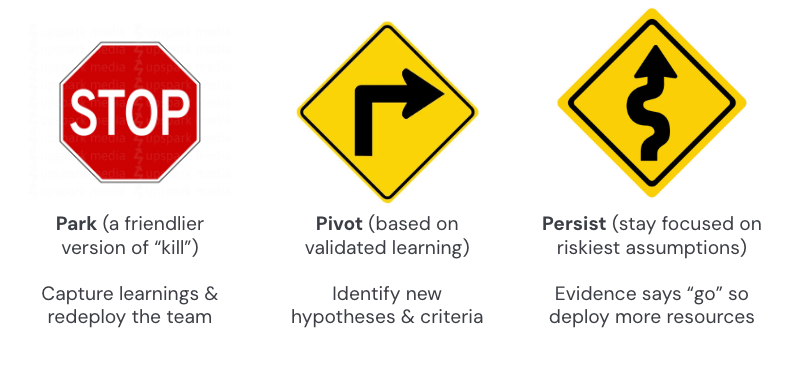
🔴 Park. The evidence says this isn't it. Capture the learnings, redeploy the team, move on.
🟢 Persist. The evidence says go. The riskiest assumptions are holding up. So deploy more resources and push.
🟡 Pivot. Something you learned invalidated the original path, but there's a real new hypothesis worth testing. Reset the criteria and go again.
We say “park” but we mean “kill.” Not to soften it into meaninglessness, but because parking a project is not a judgment of the people who worked on it. It's a portfolio allocation decision. You're moving limited resources to where they'll create the most value. That's the job. That's literally what managing a portfolio means.
This reframe matters more than it looks. Because the reason people don't stop projects is that stopping feels like personal failure, theirs or someone else's. If you can make stopping a normal, even valuable, output of the process, you remove the fear that creates zombies in the first place.
Every honest practitioner figures this out eventually: failure is just a fast cycle through part of the process. A team that's serious about getting good at venture building needs those cycles. The process only improves with more sets and reps. Every project generates value, even the ones you park. Sometimes the learning integrates back into the core business. Sometimes it kills a bad idea before it eats two years of budget. That's a win too.
If you work in innovation, this has to be part of your job description. Not just building things. Recommending when to stop them. Every innovator is used to the idea of presenting things to stakeholders, but often they skip the key step, which is presenting a go/no-go decision.
The flow is simple:
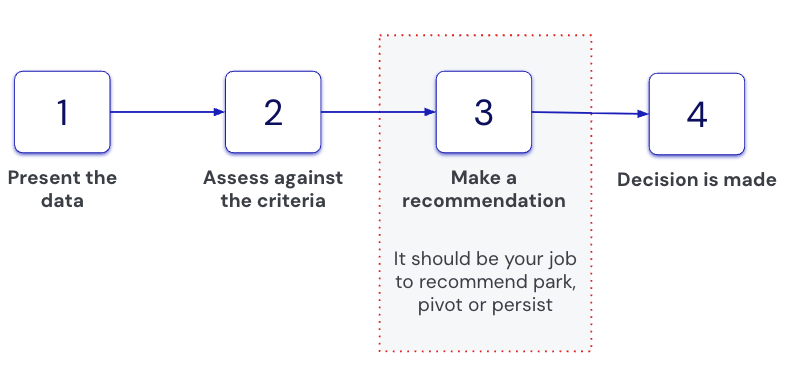
1️⃣ Present the data.
2️⃣ Assess it against the criteria you set in advance.
3️⃣ Make a recommendation: park, pivot, or persist.
4️⃣ Let the decision get made.
The bravest, most credible innovators we know are the ones willing to stand up and recommend parking their own project. It's the opposite of what the system usually rewards, and it's exactly what makes the portfolio work.
This is the last post in the series. We started with volume (more bets than you think), moved to measurement (the foundation that makes prioritization honest), and ended here, with the courage to act on what the data says. All three have to work together. Volume without discipline is spray and pray. Discipline without volume is a single big bet. You need both.
So, three honest questions to end on. Look at your portfolio:
Unfortunately, it’s often all three. But recognizing that is a good starting point.
Curious to learn more? Reach out to us at info@highlinebeta.com.