Oops! Something went wrong while submitting the form.
There's a reason so many corporate innovation projects become zombies.
It's not that the people running them are incompetent. It's not even that the ideas are necessarily bad. It's that the system makes it almost impossible to stop.
When criteria aren't set in advance, when the culture treats stopping as failure, when individual career incentives don't reward honest assessment, projects just keep going. Nobody wants to be the person who raised their hand and said "I don't think we should pursue this anymore." So the project lingers. Resources keep getting consumed. And the portfolio fills up with the undead.
Zombie ventures are not a sign of bad people. They are a sign of a bad system.
The language we use matters. "Killing" a project sounds brutal. It sounds like a verdict on the team that built it, the leader who championed it, the time and money that went into it.
That framing is wrong, and it's causing real damage.
Parking a project is not a judgment on the people involved. It's a portfolio allocation decision. It's taking limited resources and putting them where they'll create the most value. That's not failure. That's how good portfolio management works.
Venture capitalists understand this intuitively. A VC doesn't take it personally when a startup in their portfolio doesn't work out. They expect most bets to fail. The system is designed around that expectation. The portfolio absorbs the losses, and the winners carry it.
Corporate innovation needs the same logic. When a project gets parked, that's not the end of something. It's the redeployment of something: people, attention, budget, learning. The team doesn't disappear. The work wasn't wasted. The organization just made a rational decision about where to focus next.
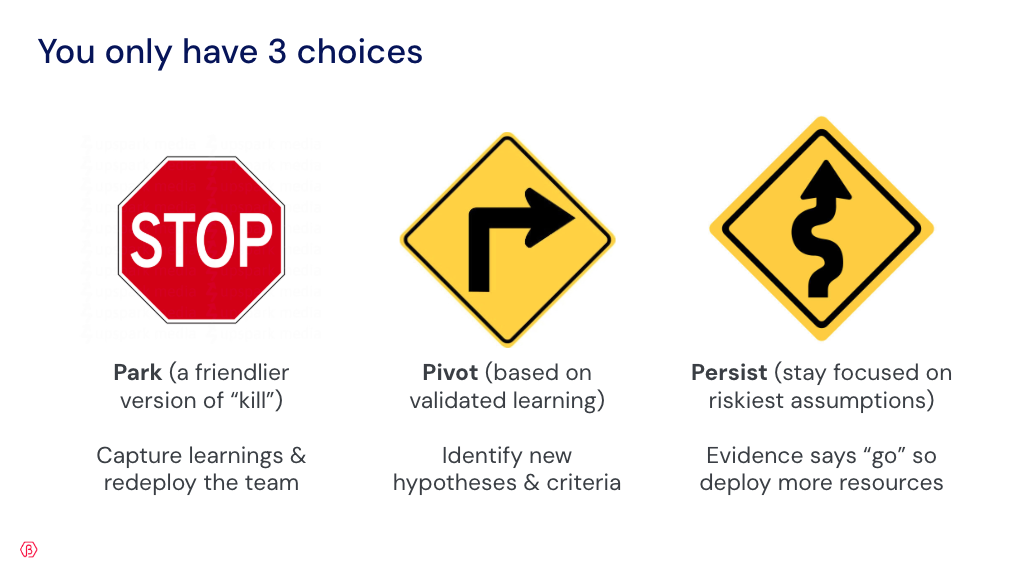
At any point in your innovation portfolio, every project has exactly three paths forward.
Park it. The evidence isn't there. Stop, capture what you learned, and move on. The faster you do this, the more of your resources you preserve for things that are actually working.
Pivot it. Something you learned points to a different direction. Reframe the hypothesis, set new criteria, and pursue that direction with discipline. A real pivot is driven by validated learning, not by a reluctance to admit the original direction isn't working.
Persist with it. The evidence says keep going. Stay focused on the riskiest assumptions, deploy more resources, and push forward. Even here, "persist" doesn't mean a straight line. It means continuing to test and learn, just with more fuel behind it.
The problem is that most organizations default to a fourth option that isn't on this list: keep going without evidence, for reasons that have nothing to do with the work itself. That's how zombies are made.
Here's what often gets missed in conversations about killing bad bets: the discipline cuts both ways.
Parking things that aren't working is one half of portfolio management. The other half is going all-in on the things that are.
Corporate innovation, like venture capital, is a game of outliers. One venture, if you've built the portfolio right, does the heavy lifting. But that only happens if you're willing to actually back it. You can't spread resources thinly across everything and expect miracles. You can't protect the portfolio from risk by giving every project just enough to survive.
The willingness to stop things has to be matched by the willingness to bet big on the things that deserve it. Many organizations are better at the former than the latter. Even when a venture is clearly working, the investment feels scary. What if it doesn't scale? What if we put in more and it still fails?
But if you've already done the work to identify a winner, starving it of resources is just a slower way to lose.
When Highline Beta worked with RBC to build their venture studio, the team tested hundreds of ideas over five years. About 15 internal ventures were built. Of those, four scaled. Each of those four, Dr. Bill, Houseful, Ownr, MyDOH, received real resources once the evidence supported them. They didn't succeed by accident. They succeeded because someone made the decision to go all-in.
The ventures that were parked along the way weren't failures. They were the system working correctly.
If you work in innovation, this is part of your job description whether it's written there or not.
Present the data. Assess it against criteria that were set in advance. Make a recommendation: park, pivot, or persist. Then let the decision-making process run its course.
The piece that's missing in most organizations is that last step before the decision: the recommendation. Innovation teams do the work, present the findings, and then wait for someone above them to decide. The person closest to the work, who knows it best, often stays silent on what should actually happen next.
That has to change. If you're running an innovation project and the evidence says it's not working, it should be your job to say so. Not to protect your position or manage perception. To be intellectually honest with the organization about where its resources should go.
That takes courage. It also takes a system that makes it safe to be courageous.
Managing the portfolio is the job. The accountability, the honesty, and the willingness to act on the data, all of it. Not just the exciting parts.