Oops! Something went wrong while submitting the form.
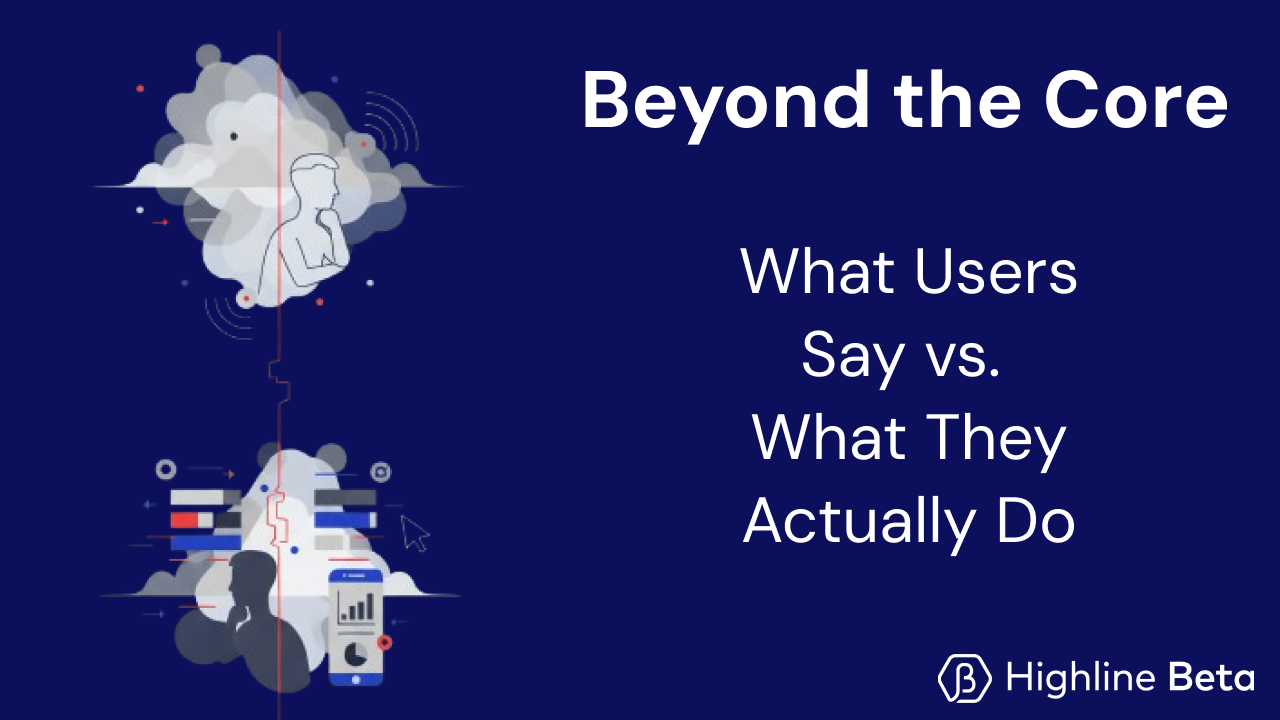
As of 2025, Highline Beta argues that user research fails when teams listen to what people say rather than observing what they actually do, leading to solutions that don't achieve real traction or adoption.
Users frequently express interest in solutions they've never searched for, claim they'd use products they don't sign up for, and cite time constraints while spending significant time on unproductive activities. Highline Beta's discovery sprint methodology focuses on uncovering behavioral patterns through workarounds, emotional cues, frequency of pain points, decision moments, and contextual factors rather than relying on hypothetical responses. In one oral care sprint, users claimed they skipped brushing because they were "too tired," but deeper investigation revealed the real issue was guilt about failing their entire nighttime routine, shifting the solution focus from prevention to permission.
Teams should examine workarounds and duct-tape solutions users have created, emotional reactions like lighting up or hesitating during conversations, frequency and recency of pain points, decision moments that tipped users into action, and contextual clues about when problems occur. These behavioral indicators reveal actual user needs rather than hypothetical preferences that often don't translate to real adoption.
Effective interviews ask for specific stories about recent experiences rather than hypothetical scenarios, since people are poor at predicting future behavior but accurate about past actions. Probe with neutral questions like "What else did you try?" and "Why that solution?" while avoiding pitching solutions early, which biases conversations. When showing concepts, present multiple sacrificial ideas so users stop trying to give the "right" answer.
Users initially claimed they skipped brushing because they were "too tired," but deeper behavioral analysis revealed the real problem was guilt about failing their entire nighttime routine, causing them to give up altogether, use mints as substitutes, or avoid bathroom mirrors. This insight shifted the solution approach from prevention-focused features to permission-based flexibility, demonstrating how surface-level answers can mask the actual underlying problems.
Research fails when teams accept surface-level responses like "I'd totally use that" without investigating actual behaviors and decision-making patterns. Users may express enthusiasm for concepts they've never actively sought solutions for, or claim interest without taking concrete steps like signing up for prototypes. The disconnect between stated intentions and actual behaviors explains why many well-researched products still struggle with real-world traction and adoption.
They say: “Yeah, that’s a nice idea.”
→ But they’ve never searched for anything like it before.
They say: “I’d totally use that.”
→ But they didn’t sign up for the prototype.
They say: “My schedule is too packed to do [x].”
→ But they spend 40 minutes scrolling Instagram before bed.
Words are easy. Actions are real. Design your interviews and tests to dig into behaviors, not words.
In every discovery sprint, you should focus on:
Workarounds
What hacks or duct-tape solutions have they built to cope with the challenges they’re facing?
Emotional cues
Do they light up, hesitate, apologize, or get frustrated when talking about something? That’s gold.
Frequency and recency
When was the last time they felt this pain? How often does it show up? What do they do when it does?
Decision moments
What trade-offs did they make? What tipped them into action?
Context clues
What’s happening around them when the problem occurs?
Don’t just ask, “What’s hard?” Ask, “What did you do about it?”

Design your interviews to reveal more than polite answers.
Ask for stories
Stories give you behavior, not hypotheticals. People are notoriously bad at predicting their future behavior, but stories come from actual past decisions and actions, making them more concrete.
Probe without leading
Open-ended, neutral questions unlock better signals.
Avoid pitching
Testing solutions too early biases the conversation. Stay in the problem space and try to dig into the underlying pain points and consequent behaviour.
Use stimulus carefully
When showing ideas, show multiple sacrificial ones so people stop trying to “get it right.”
In one sprint, we explored oral care routines. Users said they skipped brushing because they were “too tired.”
But that wasn’t the real problem.
The deeper issue was guilt. They felt like they’d failed their entire nighttime routine by missing a step. So they gave up altogether. Or used a mint. Or avoided the bathroom mirror.
That insight shifted everything.
It moved us from prevention to permission.
From rigidity to flexibility.
From features to feelings.
And it happened because we watched what people did—not just what they said.
If your research isn’t leading to traction and adoption for your idea, it might not be the solution itself that’s wrong.
It might be the surface-level answers you’re listening to.
Look closer.
The real problem is usually hiding just beneath the “yeah, I think I’d use that.”
Want to learn how to interview users more effectively? Let us know at hello@highlinebeta and we can share our interview guide.